
2024 · Psychometrika · 89(1), 241–266
Author’s introduction (LinkedIn)
Journal DOI: 10.1007/s11336-023-09944-3 Open access
Abstract
Generalized structured component analysis (GSCA) is a multivariate method for examining theory-driven relationships between variables including components. GSCA can provide the deterministic component score for each individual once model parameters are estimated. As the traditional GSCA always standardizes all indicators and components, however, it could not utilize information on the indicators’ scale in parameter estimation. Consequently, its component scores could just show the relative standing of each individual for a component, rather than the individual’s absolute standing in terms of the original indicators’ measurement scales. In the paper, we propose a new version of GSCA, named convex GSCA, which can produce a new type of unstandardized components, termed convex components, which can be intuitively interpreted in terms of the original indicators’ scales. We investigate the empirical performance of the proposed method through the analyses of simulated and real data.
Version of record · Abstract source · CC BY 4.0
Figures 3 images
Select an image to view it at full size. Captions identify the source and version.
Figure 1
Caption & source
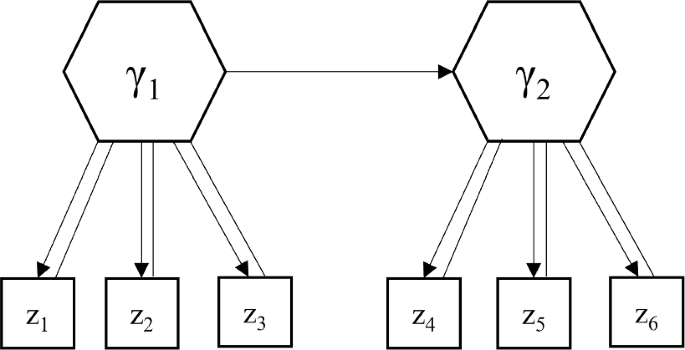
An illustrative GSCAcvx model. Hexagons represent components, squares denote indicators, straight lines indicate weights, single-headed arrows denote loadings and path coefficients. All intercepts and error terms are omitted to make the figure concise.
Version of record · Figure source · CC BY 4.0
Figure 2
Caption & source
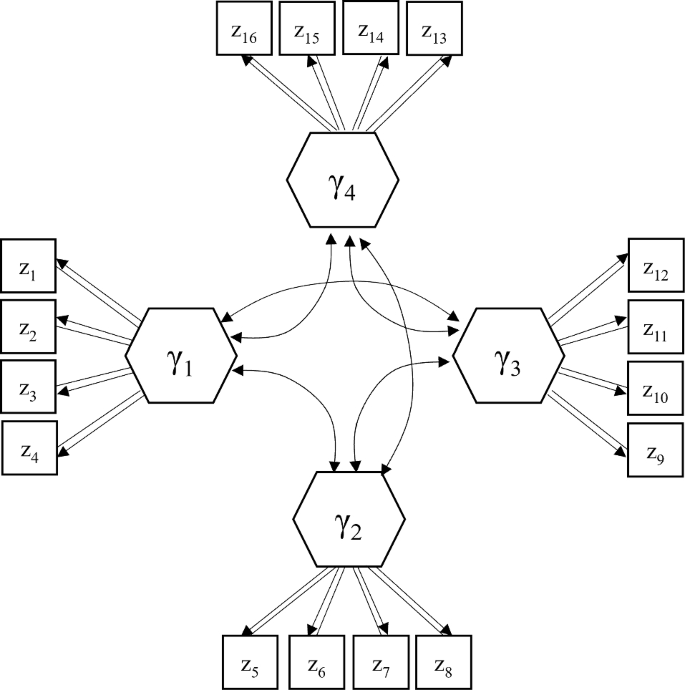
The population GSCAcvx model used in the simulation study. Double-headed arrows represent correlations. All intercepts and error terms are omitted to make the figure concise.
Version of record · Figure source · CC BY 4.0
Figure 3
Caption & source
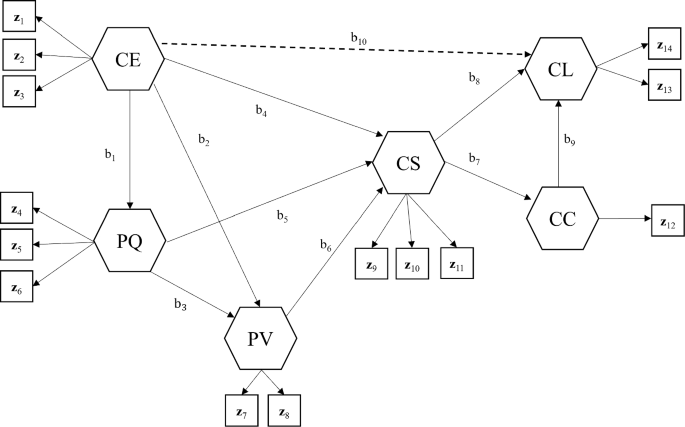
The ACSI model. The dashed line labeled b10 signifies an incorrectly specified path coefficient. All weights and error terms are omitted to make the figure concise. CE = customer expectations, PQ = perceived quality, PV = perceived value, CS = customer satisfaction, CC = customer complaints, CL = customer loyalty.
Version of record · Figure source · CC BY 4.0
Versions & resources
Peer-reviewed journal article
Psychometrika · 2024
DOI: 10.1007/s11336-023-09944-3Cite this work
Cho, G., & Hwang, H. (2024). Generalized structured component analysis accommodating convex components: A knowledge-based multivariate method with interpretable composite indexes. Psychometrika, 89(1), 241–266. https://doi.org/10.1007/s11336-023-09944-3