
2026 · PLOS One · 21(8), e0352880
Journal DOI: 10.1371/journal.pone.0352880 Open access
Preprint DOI: 10.31234/osf.io/c7zkb_v1
Abstract
Emotion regulation is widely recognized as a critical factor in offender rehabilitation and recidivism reduction. However, empirical research has not yet clarified how distinct patterns of cognitive emotion regulation strategies (CERS) relate to recidivism across different types of criminal offenses. We therefore constructed a Bayesian network to model the probabilistic relationships between CERS and recidivism, conditioning on crime type. To obtain a practical, parsimonious network, we first derived interpretable summary indexes from multiple CERS indicators using convex generalized structured component analysis and used these indexes as network nodes. The resulting network suggested that CERS may vary across crime types and are differentially associated with the conditional probability of recidivism. These findings highlight the potential value of considering both individual CERS profiles and crime type in future research on correctional assessment and intervention planning.
Version of record · Abstract source · CC BY 4.0
Figures 7 images
Select an image to view it at full size. Captions identify the source and version.
Figure 1
Caption & source
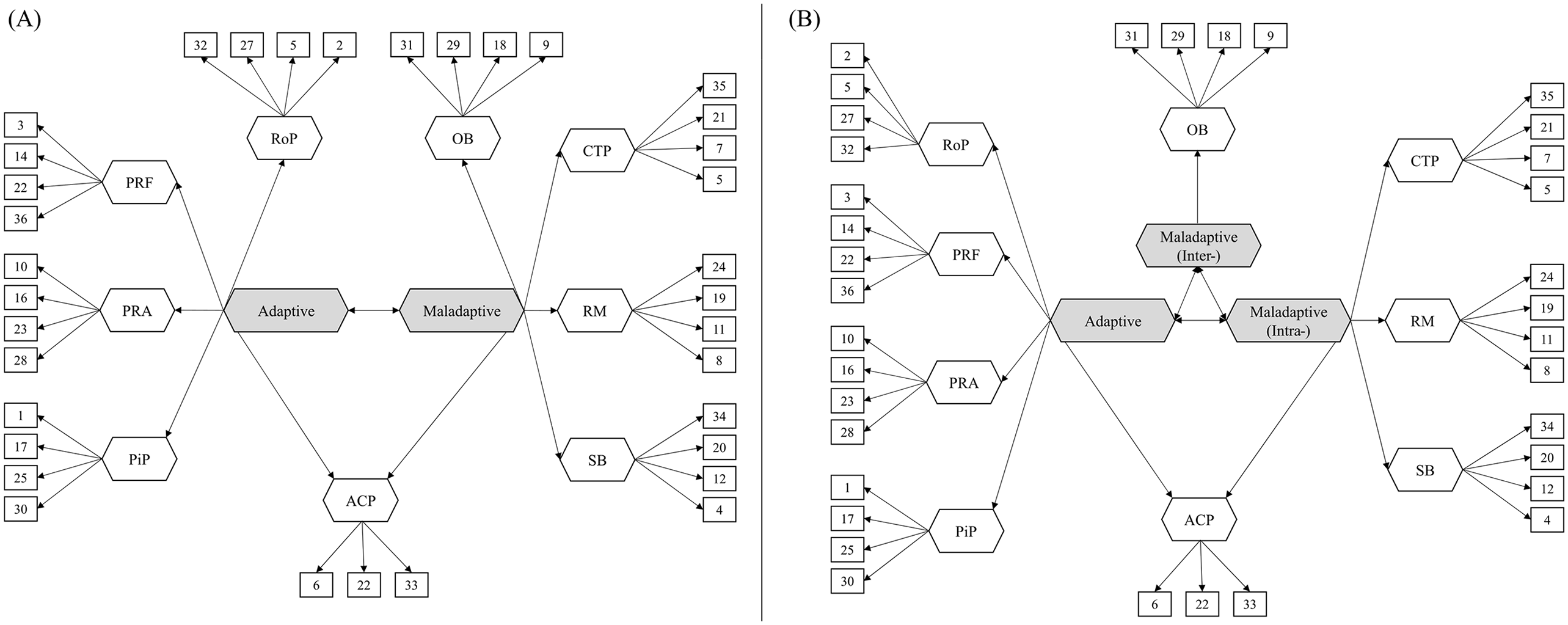
Two competing GSCA models.
Squares denote items, hexagons signify components, directional arrows indicate loadings, and bi-directional arrows represent correlations. The second-order components are colored in gray. For simplicity, weights and error terms are omitted (RoP = Refocus on planning, PRA = positive reappraisal, PiP = putting into perspective, ACP = acceptance, SB = self-blame, RM = rumination, CTP = catastrophizing, and OB = other-blame). Panel (A) shows the model with two second-order components, whereas Panel (B) shows the model with three second-order components.
Version of record · Figure source · CC BY 4.0
Figure 2
Caption & source
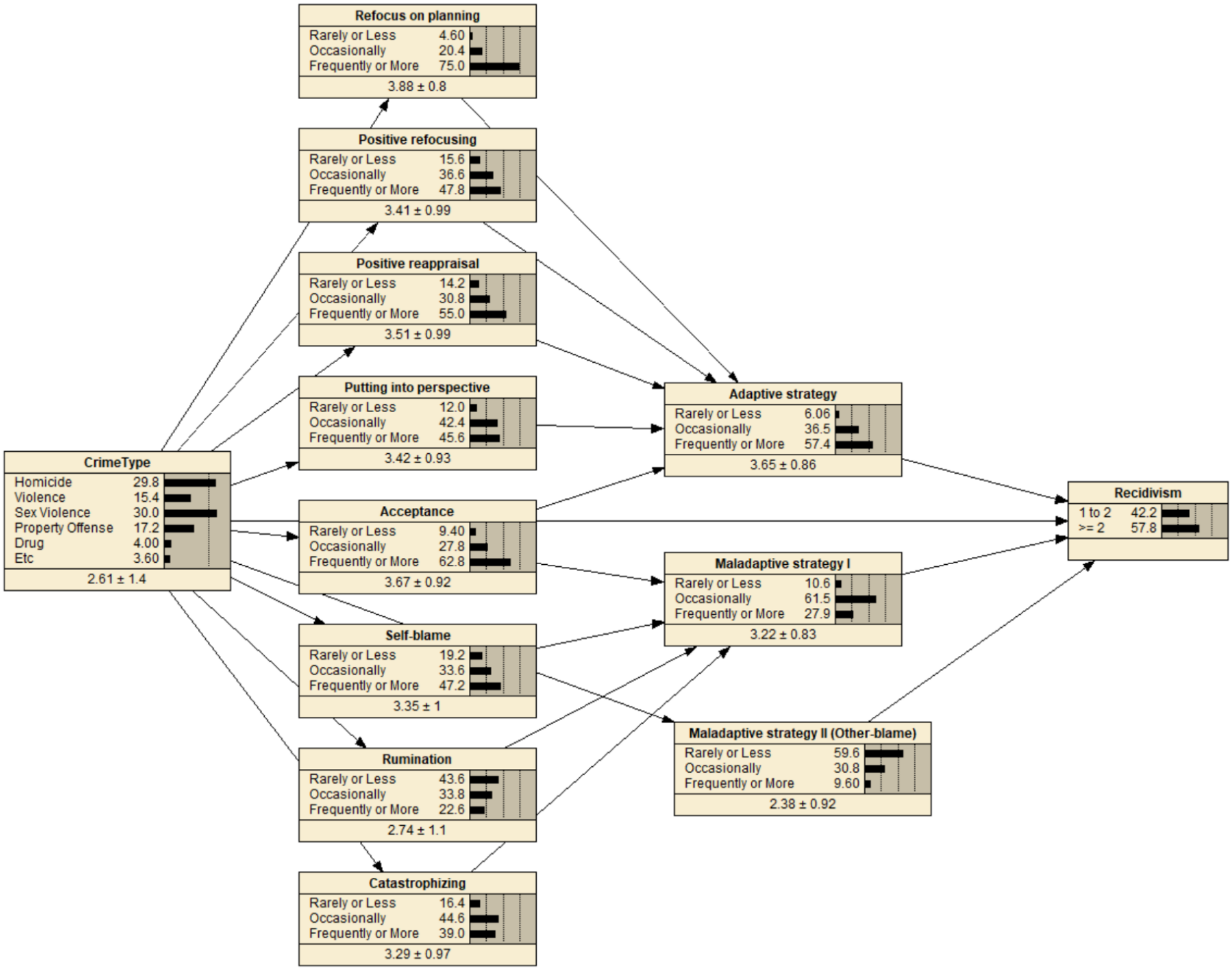
Bayesian network for cognitive emotion regulation strategies and Recidivism.
Version of record · Figure source · CC BY 4.0
Figure 3
Figure 4
Caption & source
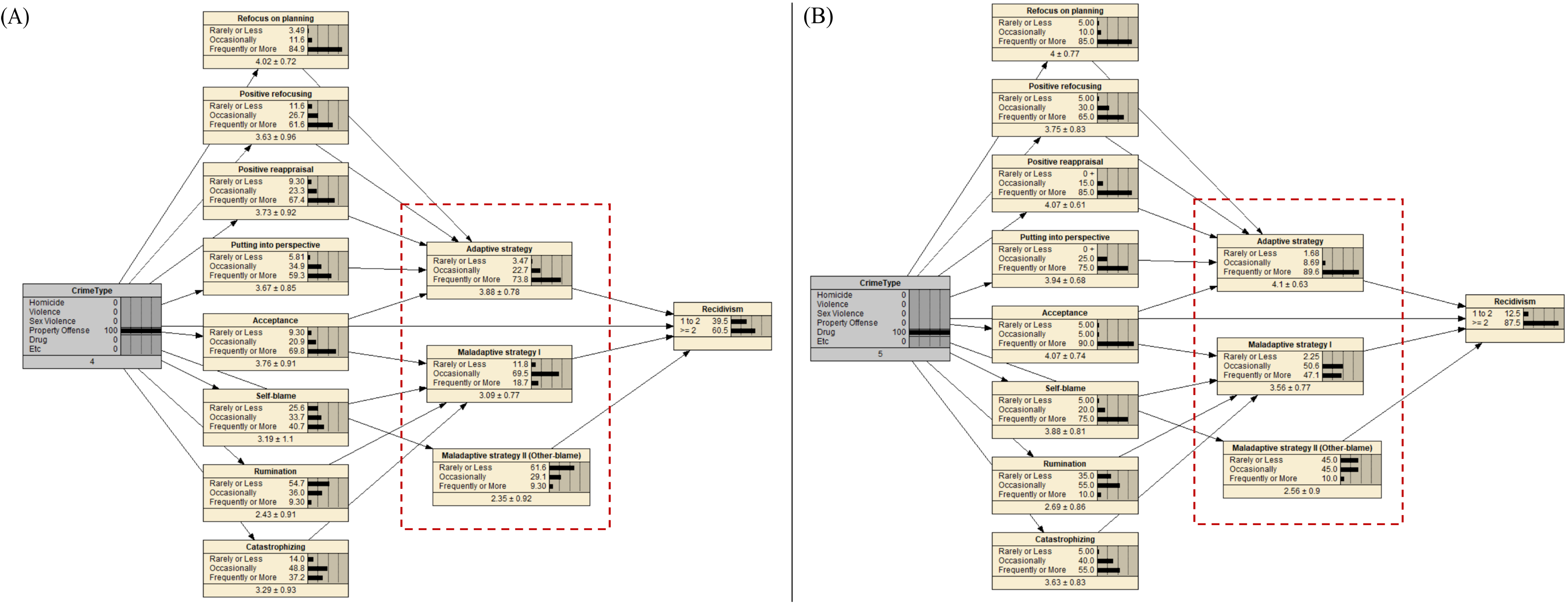
Example conditional probability patterns of CERS across criminal categories in the Bayesian network.
(A) Conditional probability pattern for property offenders. (B) Conditional probability pattern for drug offenders.
Version of record · Figure source · CC BY 4.0
Figure 5
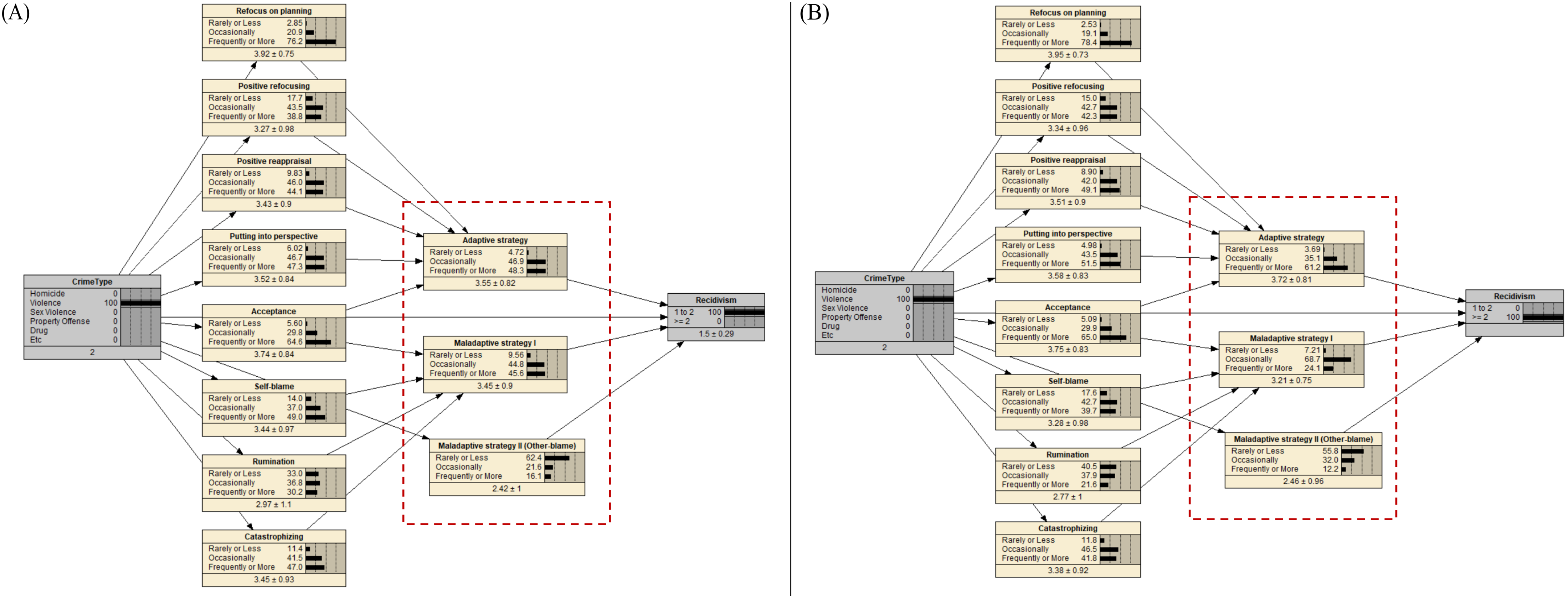
Caption & source
Conditional probability patterns of adaptive and maladaptive CERS among violent offenders by recidivism status.
(A) Conditional probability pattern for first-time offenders. (B) Conditional probability pattern for re-offenders.
Version of record · Figure source · CC BY 4.0
Figure 6
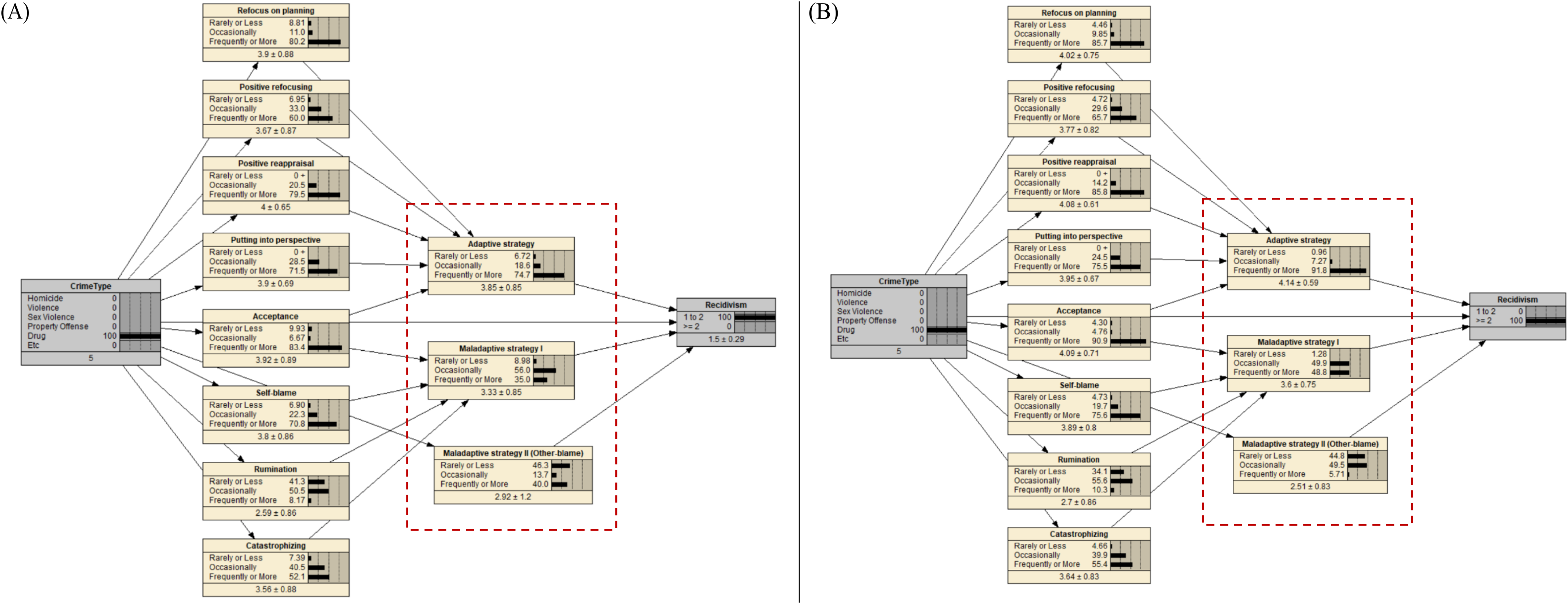
Caption & source
Conditional probability patterns of adaptive and maladaptive CERS among drug offenders by recidivism status.
(A) Conditional probability pattern for first-time offenders. (B) Conditional probability pattern for re-offenders.
Version of record · Figure source · CC BY 4.0
Figure 7
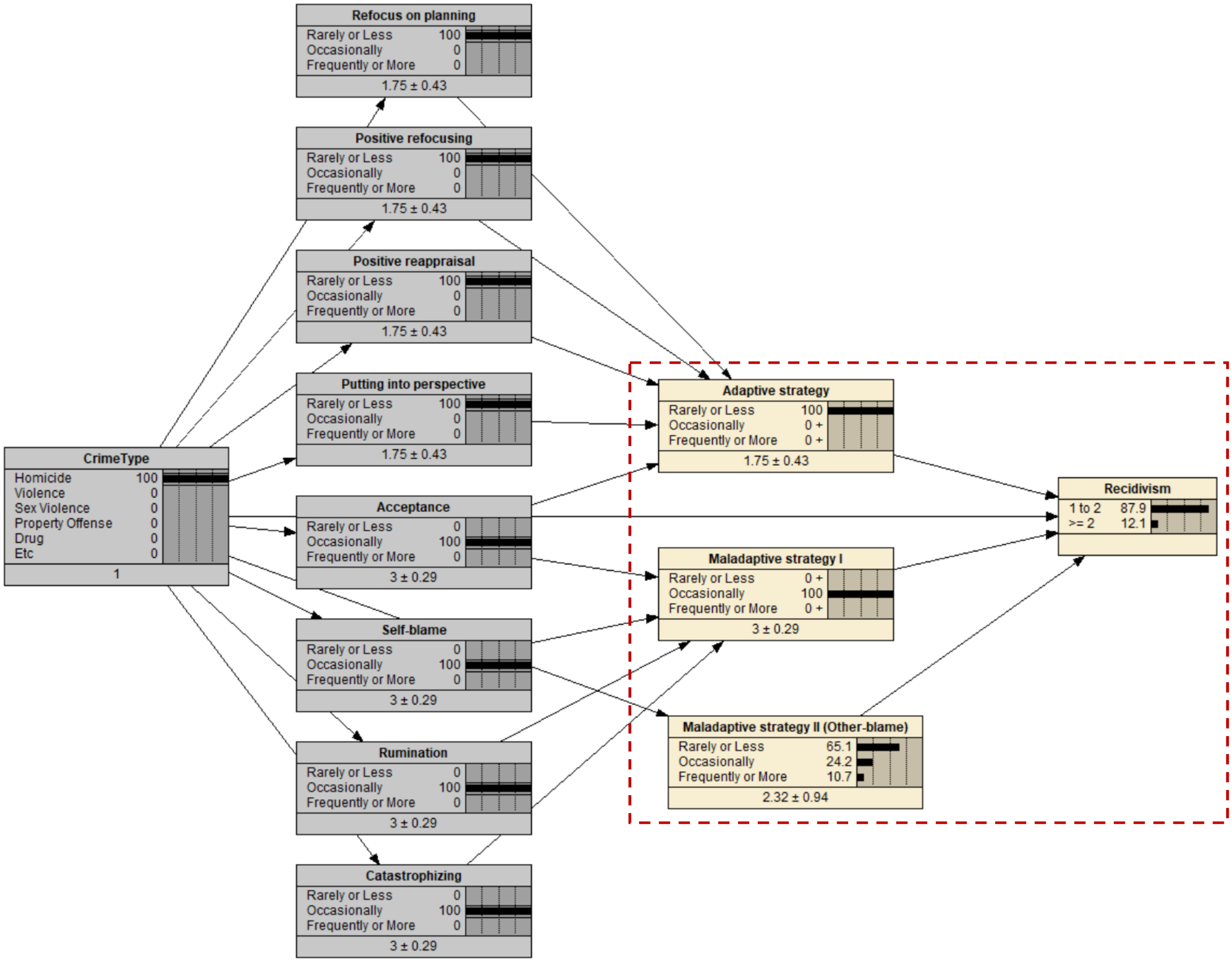
Caption & source
Examples of conditional probability of recidivism in a Bayesian network.
Version of record · Figure source · CC BY 4.0
Versions & resources
Peer-reviewed journal article
PLOS One · 2026
DOI: 10.1371/journal.pone.0352880Public preprint, version 1
Posted 2025-10-24
Cite this work
Choi, Y., & Cho, G. (2026). Modeling conditional dependencies between recidivism and cognitive emotion regulation strategies among prisoners using a Bayesian network with interpretable summary indexes. PLOS One, 21(8), e0352880. https://doi.org/10.1371/journal.pone.0352880