
2023 · Structural Equation Modeling: A Multidisciplinary Journal · 30(3), 364–377
Author’s introduction (LinkedIn)
Journal DOI: 10.1080/10705511.2022.2126360 Accepted Manuscript
Accepted Manuscripts (AM)
Author accepted manuscript (PDF)
Author accepted manuscript. The final published version is available at https://doi.org/10.1080/10705511.2022.2126360.
Abstract
Jöreskog’s covariance-based approach (JCA) has been considered a standard method for structural equation modeling. However, JCA is prone to the occurrence of improper solutions and cannot make probabilistic inferences about the true factor scores. To address the enduring issues of JCA, we propose a data matrix-based alternative, termed structured factor analysis (SFA). Given a data matrix of indicators, SFA begins by estimating both measurement model parameters and factor scores by minimizing a single cost function via an alternating least squares algorithm, which mathematically guarantees convergence to proper solutions. It then employs the factor score estimates to estimate structural model parameters. Once all parameters are estimated, SFA further estimates the probability distribution of the factor scores that can generate the data matrix of indicators, which can be used for probabilistic inferences about the true factor scores. We investigate SFA’s performance and empirical utility through simulated and real data analyses.
Version of record · Abstract source · Author-authorized abstract
Figures
Figures are not reproduced here. Follow the source link to check access.
View source articleVersions & resources
Peer-reviewed journal article
Structural Equation Modeling: A Multidisciplinary Journal · 2023
DOI: 10.1080/10705511.2022.2126360Cite this work
Gyeongcheol Cho, & Heungsun Hwang (2023). Structured factor analysis: A data matrix-based alternative approach to structural equation modeling. Structural Equation Modeling: A Multidisciplinary Journal, 30(3), 364–377. https://doi.org/10.1080/10705511.2022.2126360
Related news
Invited talk at KAIST, School of Digital Humanities and Computational Social Sciences, Daejeon
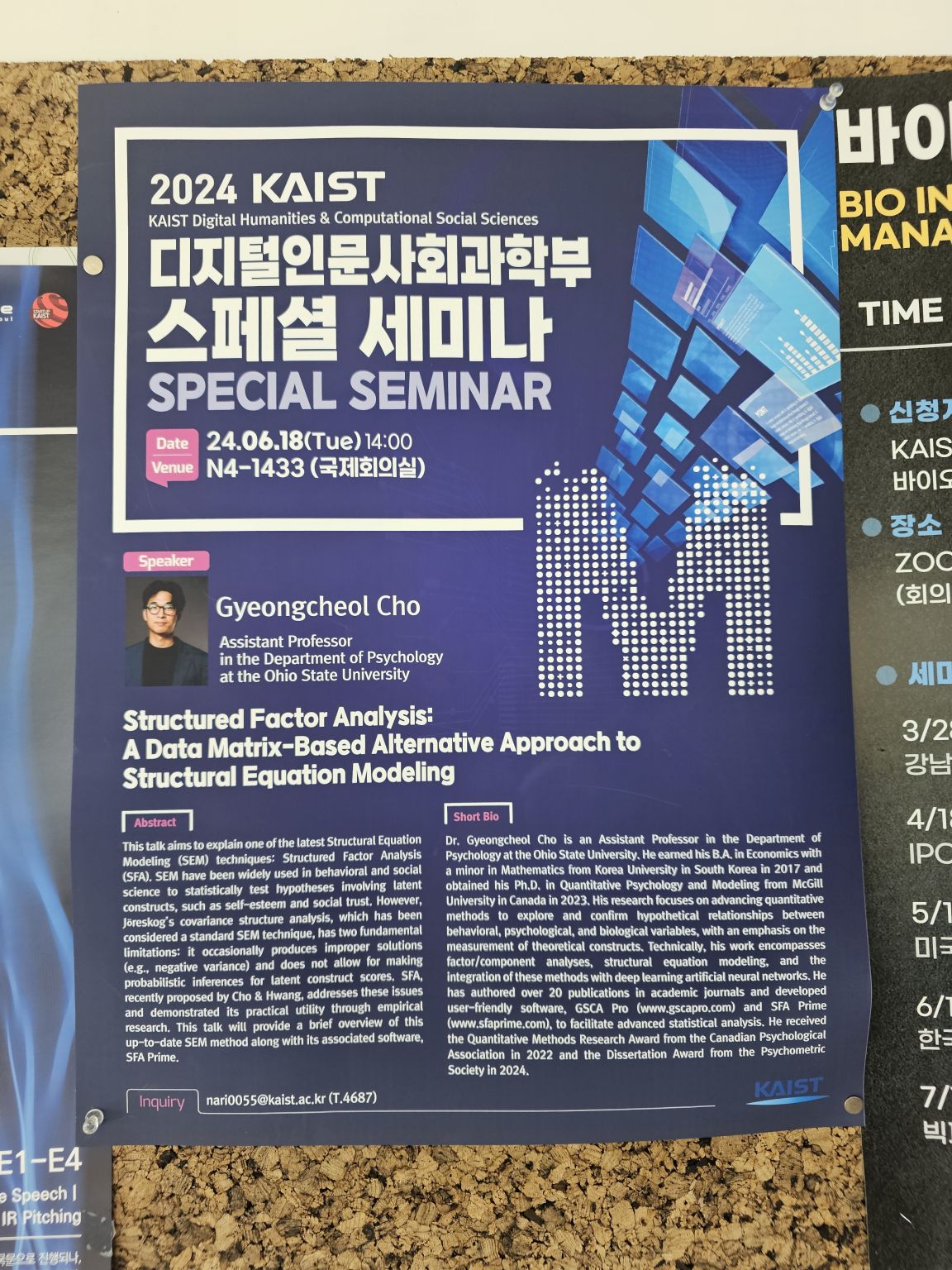
GyeongCheol Cho gave an invited presentation, “Structured factor analysis: A data matrix-based alternative approach to structural equation modeling,” at KAIST, School of Digital Humanitie…